Showing posts with label comics. Show all posts

BIG NEWS - revamp in progress

Hey everyone!

It has been almost a year since my last update, and that's in large part due to personal issues (not to mention us being affected by the war). Issue #1 is effectively complete, minus a page or two for acknowledgements, and the little work I have been able to do has been invested in finding ways to get the publishing done.

I've recently found a printer who I might be able to work with, but while I explore that I've been inspired to reconsider how and what I make available online. While I take care of that, I'm shutting down this blog until I'm ready for a proper reveal.

In the meanwhile, if you'd like to view the comic it's available in its entirety (in high resolution) on my patreon: patreon.com/fisherking

Thank you for your patience and your patronage!

Shakespeare's Sonnets: Dedication

CLICK HERE TO PREVIEW
CLICK HERE TO VIEW IN A NEW TAB
CLICK HERE TO VIEW AT HIGH RESOLUTION

These two dedication pages are slightly modified (including my handwriting, rendered with a digital pen), and have margin notes. The notes regarding the identity of the Mr W.H. and how "in the loop" Thomas Thorpe was regarding Shakespeare's intentions may be conjecture, but the rest are evidenced by the text itself.

An enormous thank you to my patrons for your continued support! If you're not already a patron, please sign up so that we can produce more pages faster, you'll gain access to exclusive content and both my and Shakespeare's eternal gratitude!


Page 34


CLICK HERE TO PREVIEW
CLICK HERE TO VIEW IN A NEW TAB
CLICK HERE TO VIEW AT HIGH RESOLUTION

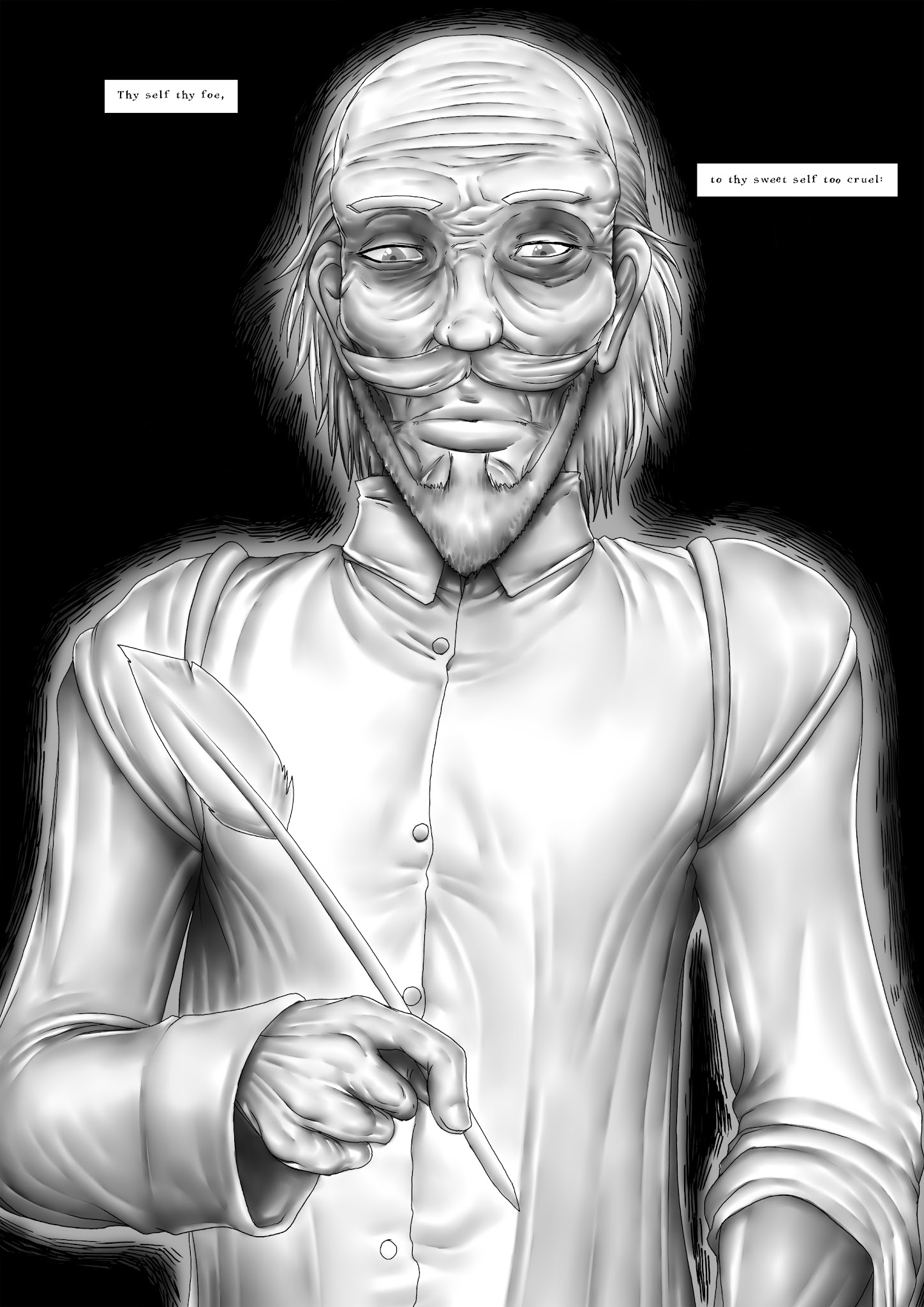
Page 34, along with its lighter reflection in page 33, illustrates the closing couplet of Shakespeare's first sonnet. In Page 34, the warning of the couplet, we see Shakespeare warning both himself and his sonnet that if he does not "pity the world" by sharing his message and publishing the sonnets, his legacy will be buried with him, and there will be no living witnesses to his love and his magic.

An enormous thank you to my patrons for your continued support! If you're not already a patron, please sign up so that we can produce more pages faster, you'll gain access to exclusive content and both my and Shakespeare's eternal gratitude!

Page 33


CLICK HERE TO PREVIEW
CLICK HERE TO VIEW IN A NEW TAB
CLICK HERE TO VIEW AT HIGH RESOLUTION

Page 33, along with its darker reflection in page 34, illustrates the closing couplet of Shakespeare's first sonnet. In Page 33, the instruction of the couplet, we see Shakespeare instructing both himself and his sonnet to "pity the world", which means both to take pity on the world and to incite the world to take pity on them. To do this, he must share his message with the world, and rolling the sonnets up and putting them in a bottle is an apt metaphor for publishing them.

He is simultaneously instructing us, the readers, to show him and his sonnets pity, and not take his words quietly to our own graves.

This line demonstrates Shakespeare's optimism that someone - you, perhaps? - will pick up his message and be convinced to love their author and let his words travel with you and live on in your heart and on your tongue.

An enormous thank you to my patrons for your continued support! If you're not already a patron, please sign up so that we can produce more pages faster, you'll gain access to exclusive content and both my and Shakespeare's eternal gratitude!

Pages 31 and 32


CLICK HERE TO PREVIEW
CLICK HERE TO VIEW IN A NEW TAB
CLICK HERE TO VIEW AT HIGH RESOLUTION

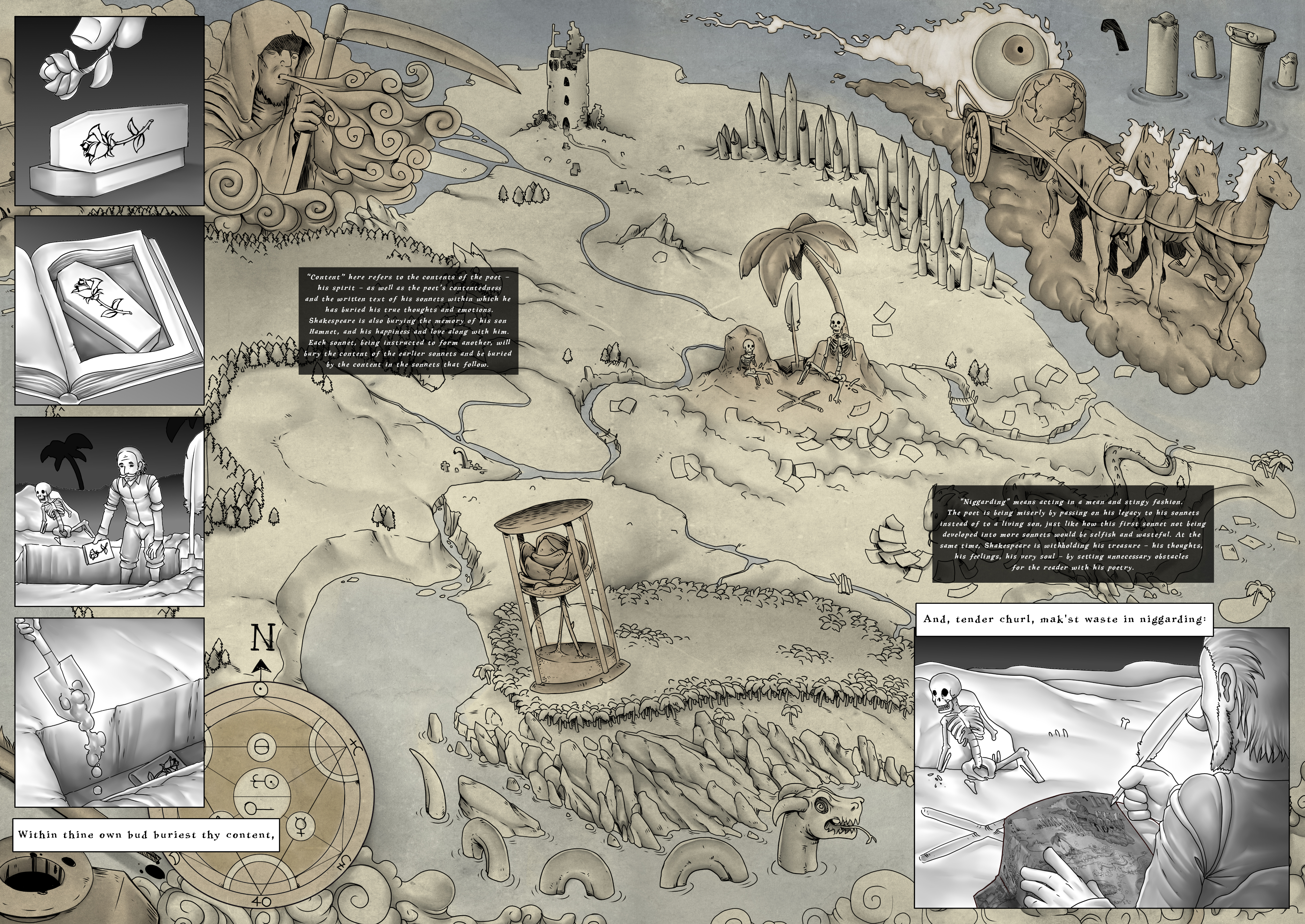
I'm very excited to present pages 31 and 32 to the public!

As the first issue draws to a close, this double-page sees Shakespeare burying his treasure and drawing a map to it with his poetry, just like the pirates of old might have done.

The map is filled with easter eggs, some of them drawn in from the tattoo project, and of course includes margin notes for one of the more famously problematic words in the sequence.

X marks the spot!

An enormous thank you to my patrons for your continued support! If you're not already a patron, please sign up so that we can produce more pages faster, you'll gain access to exclusive content and both my and Shakespeare's eternal gratitude!


Page 30

CLICK HERE TO PREVIEW
CLICK HERE TO VIEW IN A NEW TAB
CLICK HERE TO VIEW AT HIGH RESOLUTION

Shakespeare folds up his sonnet into an origami rose, which heralds the "gaudy spring" represented by a field of roses growing out of the book of sonnets. To illustrate the heralding, we see the origami rose blowing a rolled up page as a trumpet, and to illustrate heraldry, we see Shakespeare's coat of arms.

For those of you unfamiliar with the tragedy represented by the Shakespeare family's coat of arms, here's the quote from the book I published a few years ago, the first volume of Shakespeare's Sonnets Exposed:

"William Shakespeare and his father John were heavily invested in the concept of legacy, which a fair number of people in those days were, but John Shakespeare was a particularly ambitious man and in the 1560’s or 70’s had applied for a coat of arms. This was very important as it would render him a gentleman, with all that being a gentleman entailed which included being able to carry a sword. It might be of interest, then, to learn that back then the only commoners authorized to carry swords were actors and in addition to writing plays William Shakespeare’s chosen profession included acting in plays as well.

One important aspect of a coat of arms is that it was passed down from father to son. In those days, women could only bear children, not legacy, and the very idea behind a marriage contract was that the man was effectively buying the rights to a woman’s womb so that he could have a son with his name, who could then inherit whatever wealth or titles he was able to amass during his lifetime.

William Shakespeare had three children, two daughters and a son, his son Hamnet being the only child of the three who would be capable of carrying Shakespeare’s name and legacy.

Unfortunately, Hamnet died in 1596 at the tender age of 11. It is suspected that he died of the black plague, though there has been some speculation about other possibilities, but the important fact here is that his death was devastating to Shakespeare, both as a father who loved his son, and as a man being confronted by the death of his paternal legacy. A few months after Hamnet’s death, the Shakespeares were finally awarded their coat of arms - a coat of arms without a son to carry them, which I expect would have been very painful indeed."

An enormous thank you to my patrons for your continued support! If you're not already a patron, please sign up so that we can produce more pages faster, you'll gain access to exclusive content and both my and Shakespeare's eternal gratitude!

Page 29


CLICK HERE TO PREVIEW
CLICK HERE TO VIEW IN A NEW TAB
CLICK HERE TO VIEW AT HIGH RESOLUTION

In pages 27 and 28, we saw Shakespeare fueling his sonnets with his own lifeblood, his youth, his love, his creativity. Here, we see the result: an older, drained Shakespeare who has sacrificed his very essence and implanted it into the sonnet pages that he will send to us, his future readers.

An enormous thank you to my patrons for your continued support! If you're not already a patron, please sign up so that we can produce more pages faster, you'll gain access to exclusive content and both my and Shakespeare's eternal gratitude!

Pages 27 and 28


CLICK HERE TO PREVIEW
CLICK HERE TO VIEW IN A NEW TAB
CLICK HERE TO VIEW AT HIGH RESOLUTION

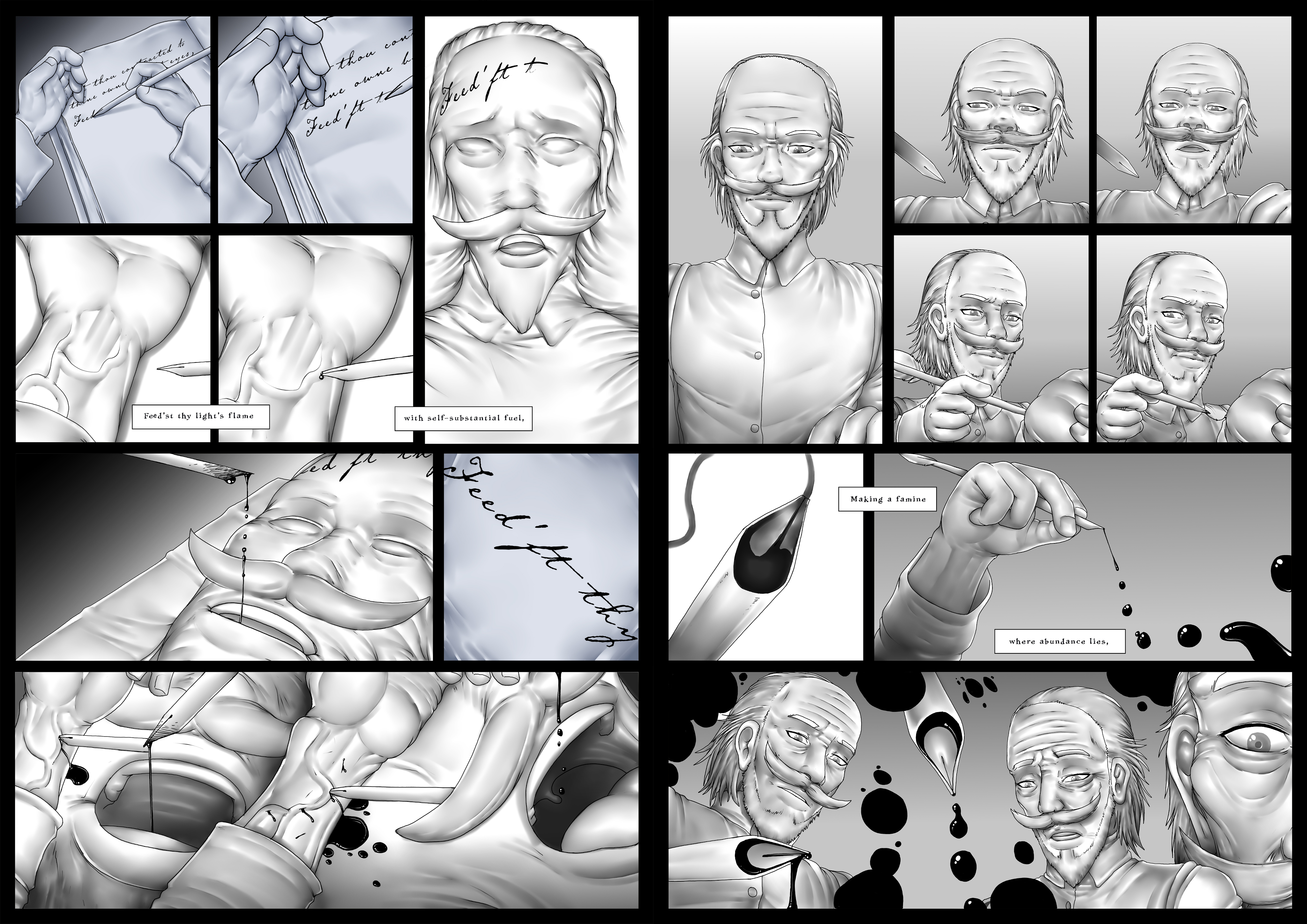
I'm very excited to present pages 27 and 28 to the public!

Page 27, and its reflection in page 28, represent the points of view of Shakespeare on the left, and the sonnets on the right. These pages illustrate the line "Feed'st thy light's flame with self-substantial fuel" which describes how Shakespeare feeds his poetry with the ink and creativity that courses through his veins.

An enormous thank you to my patrons for your continued support! If you're not already a patron, please sign up so that we can produce more pages faster, you'll gain access to exclusive content and both my and Shakespeare's eternal gratitude!


Pages 25 and 26


CLICK HERE TO PREVIEW
CLICK HERE TO VIEW IN A NEW TAB
CLICK HERE TO VIEW AT HIGH RESOLUTION

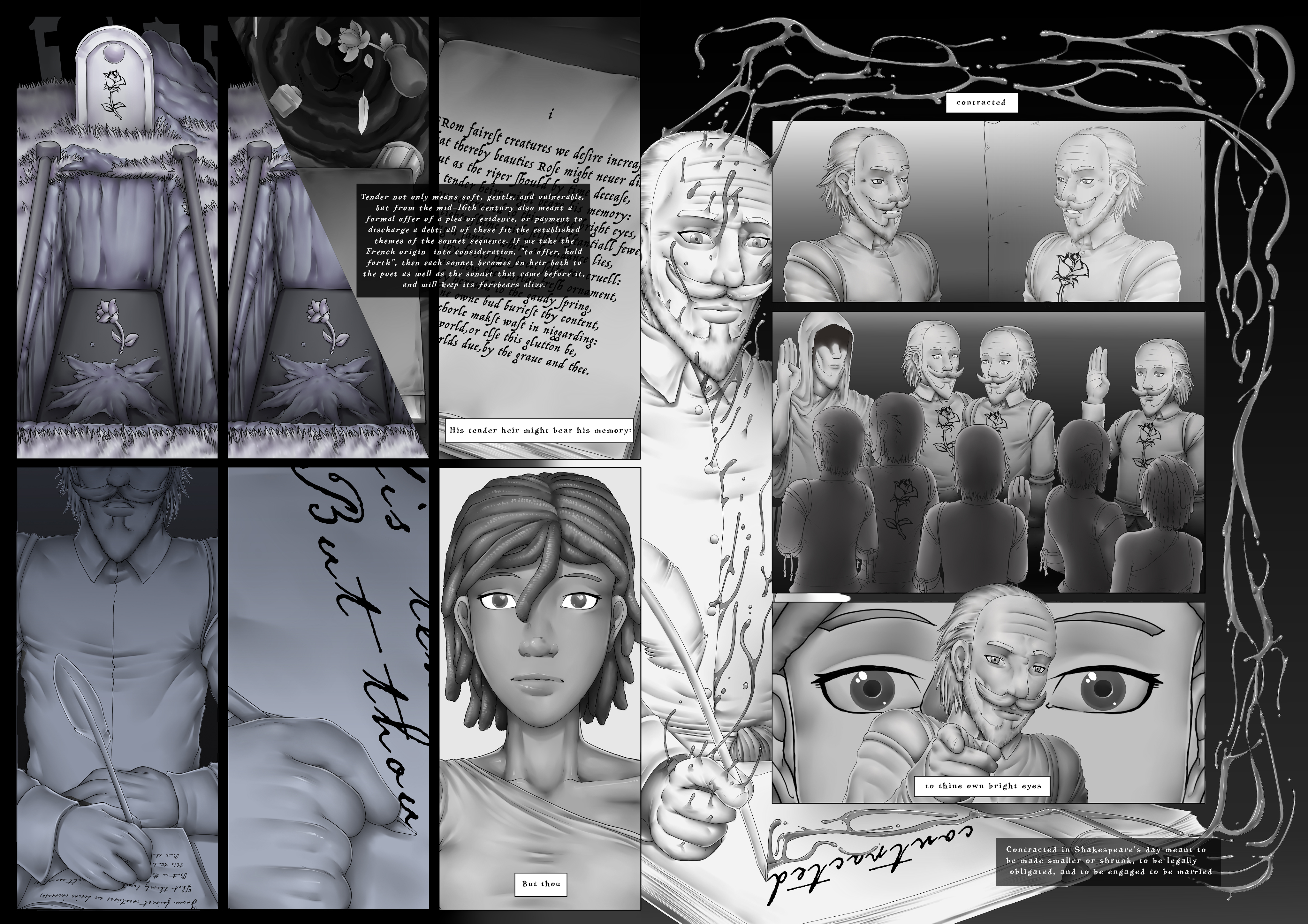
These pages were originally posted individually, but as soon as page 26 was completed we realized that their backgrounds didn't match up... so here we go!

Page 25:

Looking into the grave (whether Hamnet's or William's), the grave transforms into the book of sonnets which serves both as the remains and the legacy of the Bard. His legacy has been transported through a wormhole between the biological Shakespeare and his readers by the magic embedded in the pages, much like the rabbit-hole that Alice falls into as we're transported along with her into Wonderland.

The words of the sonnet are Shakespeare's de facto heir that bear his memory.

Where Shakespeare writes "thou", he speaks to us, the readers; we see ourselves reflected by Echo.

Page 26:

"Contracted to thine own bright eyes" is undoubtedly one of my favorite lines: in its simplest sense, contracted means "obligated to" or "married to", and this describes the "throuple" - or three-way relationship - between Shakespeare, his sonnet reflection, and the reader (Echo, or right at this very moment, you and me). At the same time, however, the sonnets are composed of the ink distilled from Shakespeare's grief, so he himself has been shrunk down into marks on the page.

Marks that have survived to tell their creator's story hundreds of years into the future.

An enormous thank you to my patrons for your continued support! If you're not already a patron, please sign up so that we can produce more pages faster, you'll gain access to exclusive content and both my and Shakespeare's eternal gratitude!

Pages 23 and 24


CLICK HERE TO PREVIEW
CLICK HERE TO VIEW IN A NEW TAB
CLICK HERE TO VIEW AT HIGH RESOLUTION

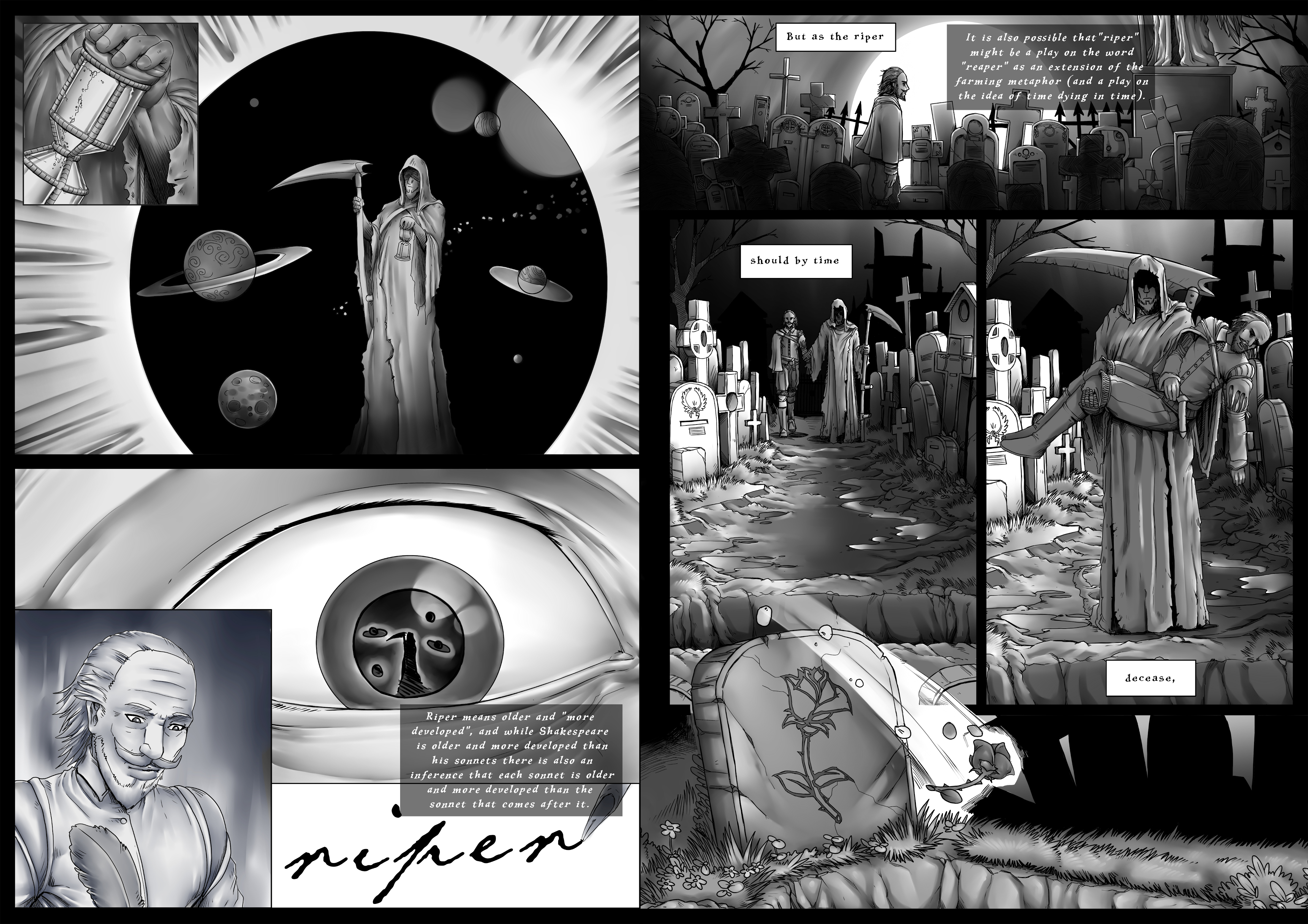
"But as the riper should by time decease": following the farming metaphor, a parent is "riper" than its child. Shakespeare is and will always be older and riper than his son, Hamnet, who was supposed to bear his memory but died at the tender age of eleven. He's also riper than his sonnets, and each sonnet is riper than its successor.

Page 23: Shakespeare, continuing to write the next line, envisions Father Time turning over the hourglass when his physical body dies.

Page 24: Shakespeare is being accompanied by Father Time on his inexorable march towards his own grave. Once his physical body is buried, his spirit will be transferred into the rose symbol inside his sonnets.

An enormous thank you to my patrons for your continued support! If you're not already a patron, please sign up so that we can produce more pages faster, you'll gain access to exclusive content and both my and Shakespeare's eternal gratitude!


Pages 21 and 22


CLICK HERE TO PREVIEW
CLICK HERE TO VIEW IN A NEW TAB
CLICK HERE TO VIEW AT HIGH RESOLUTION

Here we see the Sonnet Shakespeares themselves inspiring the birth of their own mind-child sonnets, and all of them jumping in to the sands of time to avoid Father Time's scythe. The book containing the sonnets will prove to be an excellent vehicle to protect the sonnet pages from wear and tear as they spin towards their future in the bottom half of the hourglass.

An enormous thank you to my patrons for your continued support! If you're not already a patron, please sign up so that we can produce more pages faster, you'll gain access to exclusive content and both my and Shakespeare's eternal gratitude!

Page 20


CLICK HERE TO PREVIEW
CLICK HERE TO VIEW IN A NEW TAB
CLICK HERE TO VIEW AT HIGH RESOLUTION

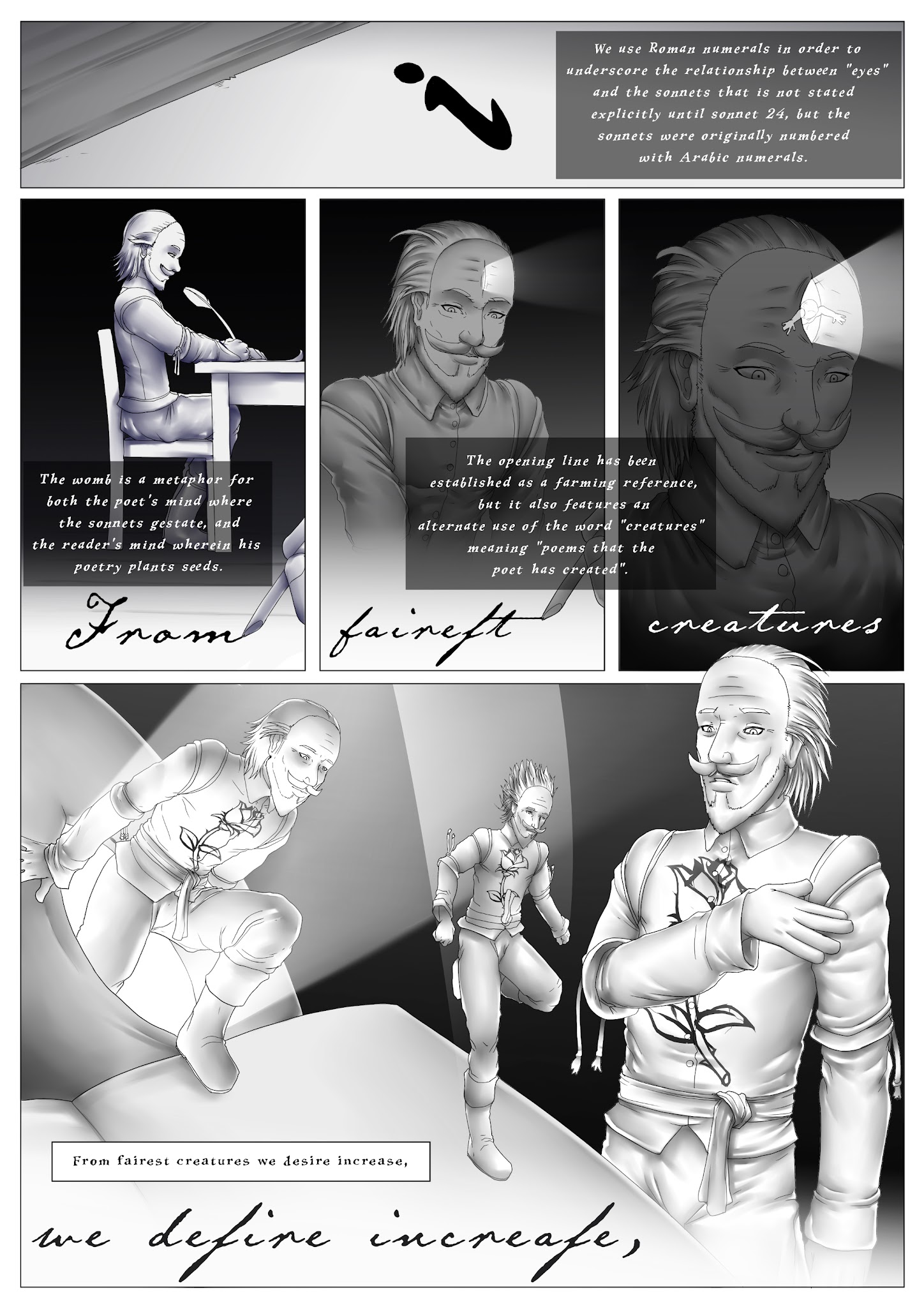
This is the opening line of the first sonnet, in which Sonnet Shakespeare is born from the third eye / mind of his maker, the "Real" Shakespeare (the Bard, the author and poet who lived 400+ years ago).

An enormous thank you to my patrons for your continued support! If you're not already a patron, please sign up so that we can produce more pages faster, you'll gain access to exclusive content and both my and Shakespeare's eternal gratitude!


Page 19


CLICK HERE TO PREVIEW
CLICK HERE TO VIEW IN A NEW TAB
CLICK HERE TO VIEW AT HIGH RESOLUTION

The text of the first sonnet as seen from the back of the sonnet's looking glass, through which we can very faintly make out the view of Echo on the other side.

An enormous thank you to my patrons for your continued support! If you're not already a patron, please sign up so that we can produce more pages faster, you'll gain access to exclusive content and both my and Shakespeare's eternal gratitude!


Page 18


CLICK HERE TO PREVIEW
CLICK HERE TO VIEW IN A NEW TAB
CLICK HERE TO VIEW AT HIGH RESOLUTION

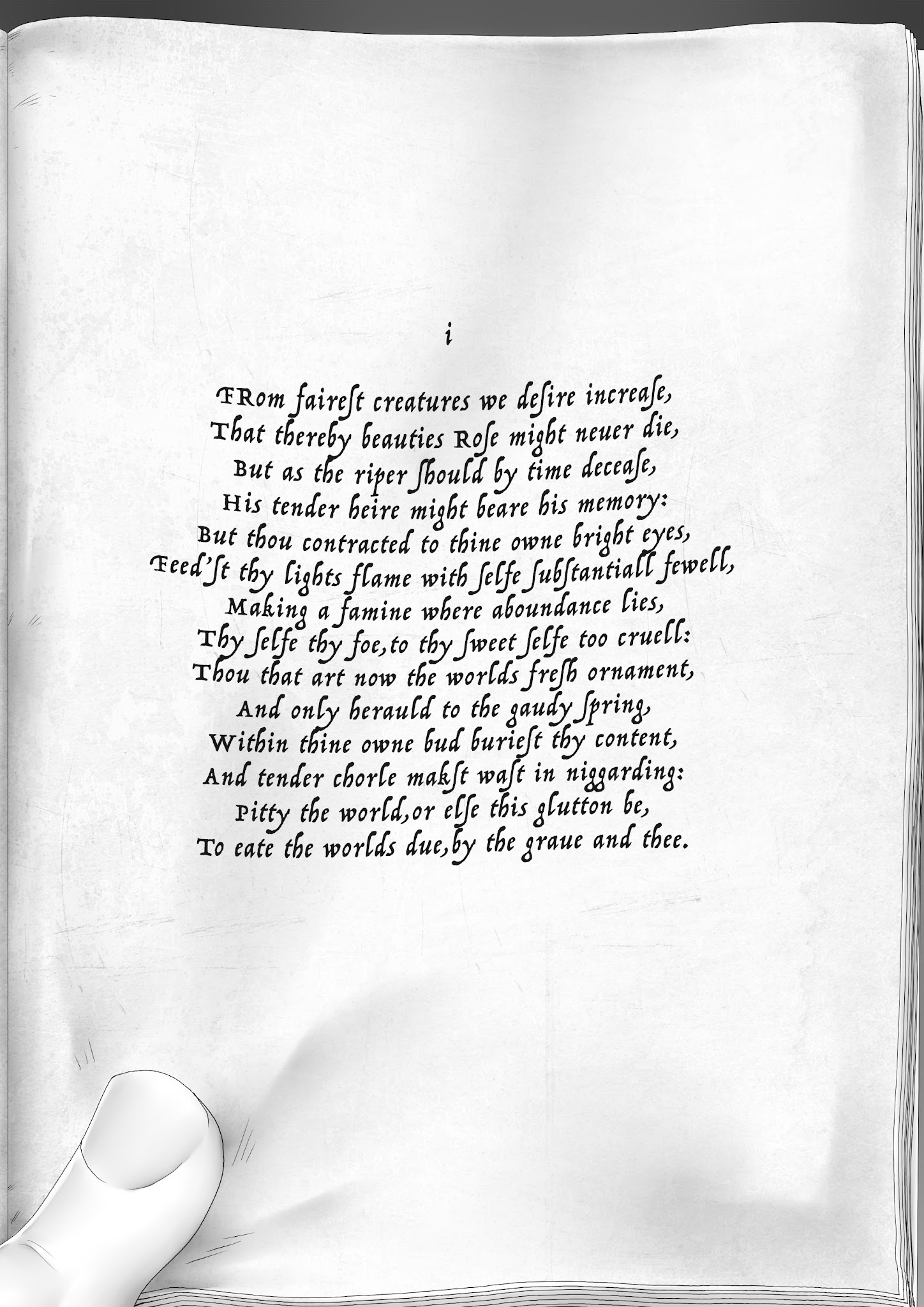
The text of the first sonnet, which we read along with Echo.

FRom fairest creatures we desire increase,
That thereby beauties Rose might never die,
But as the riper should by time decease,
His tender heir might bear his memory:
But thou contracted to thine own bright eyes,
Feed'st thy lights flame with self-substantial fuel,
Making a famine where abundance lies,
Thy self thy foe, to thy sweet self too cruel:
Thou that art now the worlds fresh ornament,
And only herald to the gaudy spring,
Within thine own bud buriest thy content,
And tender churl makest waste in niggarding:
   Pity the world, or else this glutton be,
   To eat the worlds due, by the grave and thee.

For a detailed breakdown of the sonnet, check out this video or follow the links in its description!


An enormous thank you to my patrons for your continued support! If you're not already a patron, please sign up so that we can produce more pages faster, you'll gain access to exclusive content and both my and Shakespeare's eternal gratitude!


Page 17


CLICK HERE TO PREVIEW
CLICK HERE TO VIEW IN A NEW TAB
CLICK HERE TO VIEW AT HIGH RESOLUTION

The magic moment has finally arrived - we're diving into the first sonnet! We begin looking at Shakespeare's reflection from the previous page, but now the reflection is in a puddle of ink that's drying up to form the words of the sonnet behind which the Bard's spirit is imprisoned.

We are also introduced to the reincarnation of Echo, the fickle maid from the sistering vale in "A Lover's Complaint". And, as you can see... she is us, the readers.

An enormous thank you to my patrons for your continued support! If you're not already a patron, please sign up so that we can produce more pages faster, you'll gain access to exclusive content and both my and Shakespeare's eternal gratitude!

Page 16

CLICK HERE TO PREVIEW
CLICK HERE TO VIEW IN A NEW TAB
CLICK HERE TO VIEW AT HIGH RESOLUTION

Shakespeare's vision of Narcissus and Echo has come to end, and we see that he's been looking at his reflection this whole time. The last thing he sees are the closing verses of Golding's translation... a tear falls into the water and disturbs his reflection, and on the following page we'll see how that morphs into the first sonnet.

An enormous thank you to my patrons for your continued support! And Merry Christmas to everyone celebrating!


Page 15

CLICK HERE TO PREVIEW
CLICK HERE TO VIEW IN A NEW TAB
CLICK HERE TO VIEW AT HIGH RESOLUTION
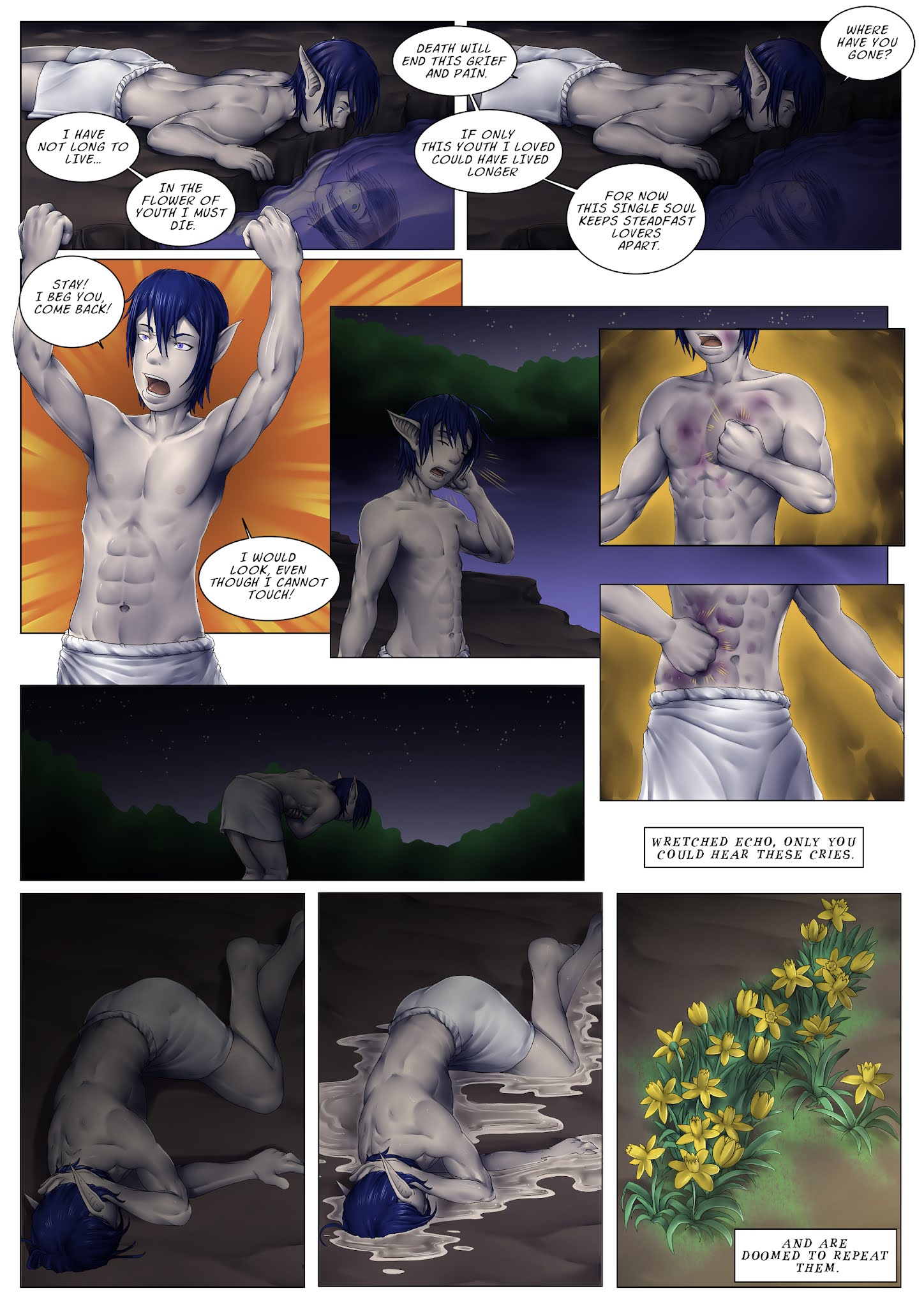
One cannot read Shakespeare’s Sonnets coherently without understanding the framing story, which is based on Arthur Golding’s translation of the story of Narcissus and Echo from Ovid’s Metamorphoses.

The final instalment of the tale of Narcissus and Echo, with Narcissus overwhelmed by grief and frustration until his collapse and metamorphosis into the Narcissus flower (daffodil). Now that the background for understanding the sonnets has been provided, the next page will transition us into the sonnets themselves - this is an important milestone, and I cannot express how excited I am that we've reached it!

An enormous thank you to my patrons for your continued support!

Pages 13 and 14

CLICK HERE TO PREVIEW
CLICK HERE TO VIEW IN A NEW TAB
CLICK HERE TO VIEW AT HIGH RESOLUTION
One cannot read Shakespeare’s Sonnets coherently without understanding the framing story, which is based on Arthur Golding’s translation of the story of Narcissus and Echo from Ovid’s Metamorphoses.

The quotes in captions are a selection that demonstrate the direct link between the tale of Narcissus and Echo and Shakespeare's sonnets; they are copied from my modernized translation of Golding's text.

Page 12

CLICK HERE TO PREVIEW
CLICK HERE TO VIEW IN A NEW TAB
CLICK HERE TO VIEW AT HIGH RESOLUTION
One cannot read Shakespeare’s Sonnets coherently without understanding the framing story, which is based on Arthur Golding’s translation of the story of Narcissus and Echo from Ovid’s Metamorphoses.

"So had he mocked this wretched Nymph and many more besides,
That lived in the waters, Woods, and groves, or Mountains.
So had he mocked many men. Of which one, unhappy
To find himself thwarted so, raised his hands to Heaven,
And said : I pray to God that he may feel fierce Cupid's fire
As I do now, but not the joy of what he desires.
The Goddesse Ramnuse (who takes vengeance on wicked people)
Agreed to his fair request out of pity."


Page 11

CLICK HERE TO PREVIEW
CLICK HERE TO VIEW IN A NEW TAB
CLICK HERE TO VIEW AT HIGH RESOLUTION
One cannot read Shakespeare’s Sonnets coherently without understanding the framing story, which is based on Arthur Golding’s translation of the story of Narcissus and Echo from Ovid’s Metamorphoses.

"Yet love still sticks to her heart, through which she daily raves
The more for the sorrow of being repulsed.
Through restless strain and worry
Her body wastes away to skin and bone, and becomes wondrously bare.
The blood vanishes into the air from out of her veins,
And nothing is left but voice and bones: the voice yet still remains:
Her bones they say were turned to stones"


Help us make more pages, faster!

Shakespeare's Sonnets: A Graphic Novel Adaptation needs you! Please sign up to support the graphic novel adaptation on Patreon and gai...

Popular Posts